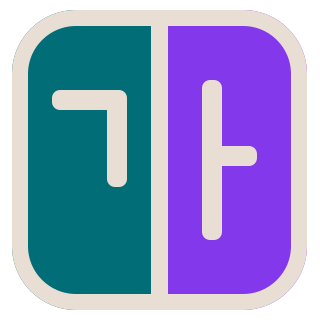
How Hangul Works: An Alphabet in Blocks
Unlike English letters that stretch out horizontally in a single line, Korean letters assemble into neat, square syllable blocks.
1. An alphabet in blocks
At first glance, Korean script looks like complex Asian characters. But Hangul is actually a pure alphabet (called jamo) consisting of consonants and vowels, just like English.
The unique difference is that instead of writing letters side by side like H-A-N-G-U-L, Korean groups letters together so that each syllable forms a balanced, visual square.
2. Consonant + vowel = syllable
The core mathematical formula of every basic Korean syllable is simple:
3. Right or underneath?
How do you know where the vowel goes? Look at the main stem of the vowel letter:
Vertical line vowels like ㅏ and ㅣ stand to the right of the consonant.
Horizontal line vowels like ㅗ and ㅡ stack underneath the consonant.
4. The silent ㅇ
Because every block must start with a consonant, Korean uses the letter ㅇ (ieung) whenever a syllable starts with an open vowel sound.
At the beginning of a block, ㅇ makes no sound at all — it simply holds the consonant spot so the block stays a proper square.
5. Letter names and sounds
Each Korean letter has a formal name (like giyeok for ㄱ, or nieun for ㄴ). Knowing letter names helps when spelling words aloud, while the sound it makes in a syllable is what you listen for when reading.
6. Spelling and pronunciation
In written Korean, each syllable maintains its original spelling block by block. In fluent spoken Korean, sounds can link smoothly across blocks (for example, 같이 is read as [가치]).
Hangulmate principle: We focus first on reading the letters and blocks clearly. Natural sound changes come easily once you can read the basic alphabet.
7. Coming next: Final consonants (Batchim)
While basic syllables contain two letters (consonant + vowel), many Korean syllables add an ending consonant at the bottom. This bottom consonant is called Batchim (받침), meaning "support" or "prop".
For example, ㄱ + ㅏ + ㄱ = 각 (gak). We will unlock batchim building in an upcoming chapter!
8. A little history
Hangul was created in 1443 by King Sejong the Great and a committee of scholars, and officially promulgated in 1446 through the document Hunminjeongeum ("The Proper Sounds for the Education of the People").
Before Hangul, Koreans wrote using complex Chinese characters, which took years of study and meant ordinary citizens could not read or write. Sejong designed an alphabet so scientific and intuitive that, as historical records noted, "a wise person can learn it in a morning, and even an ordinary person can learn it in ten days."
Put the blocks together
Try building your first syllable in our interactive tool.
Build your first syllable →